
From Physical Layer to Digital Layer: Keysight FITS-16CH and 1.6T Interconnect Validation
At 800G and 1.6T, passing optical and electrical compliance tests no longer proves that a complete cable or module will carry traffic cleanly. Keysight’s new FITS-16CH targets the next step: measuring error performance at the digital layer across every lane of a finished interconnect. This article summarizes the announcement, explains the difference between physical-layer and digital-layer testing, shows where the system sits in a high-speed lab, and covers what it means for buyers of new and pre-owned high-speed instruments.
What Keysight announced
In October 2026, Keysight announced the Functional Interconnect Test Solutions (FITS)-16CH digital-layer error performance validation system. The main points:
- 16 transmit and 16 receive channels, twice the channel density of the existing FITS-8CH.
- Combined bit error ratio (BER) and forward error correction (FEC) measurements on complete interconnect assemblies.
- 106G and 212G lane rates, covering today’s 800G interconnects and emerging 1.6T designs.
- Support for full-retimed optics (FRO), linear-retimed optics (LRO), linear pluggable optics (LPO), active optical cables (AOC), active copper cables (ACC), active electrical cables (AEC), passive direct attach cables (DAC) and copper flyover cables.
- Two Module Compliance Boards with independent channel groups, and a large insertion-loss budget for lossy channels and customer fixtures.
- A Windows 11 interface that works with a Keysight DCA-X to calculate transmit FIR tap settings automatically, which Keysight says cuts tuning from hours, days or weeks to a few minutes.
- Integration as a transmitter or receiver with Keysight DCAs, high-performance BERTs and UXR real-time oscilloscopes, plus a SCPI API and PDF and CSV reports.
Physical layer vs. digital layer: why both matter
What BER and FEC tell you that an eye diagram doesn’t
An eye diagram on a sampling oscilloscope shows the shape of the signal: amplitude, noise, jitter and how open the eye is. It is the right tool for debugging a transmitter and proving compliance. But a link that looks acceptable on one lane at one moment can still produce bursts of errors when all lanes run together, crosstalk rises, or a retimer adapts badly. BER counts actual bit errors. FEC statistics go further, showing how hard the error correction is working and whether errors arrive in patterns it cannot fix. That is the information an operator needs before trusting a cable in production.
Lane rates: 106G and 212G in context
An 800G link today typically runs eight electrical lanes at about 106 Gb/s each with PAM4 signaling. 1.6T designs move to lanes around 212 Gb/s. Doubling the lane rate shrinks the timing and voltage margin per symbol, so small losses in connectors, fixtures and cables matter far more than they did at 100G.
Optics vs. copper: decoding the acronyms
DACs are passive copper cables with no electronics. ACCs and AECs add signal conditioning or retiming to extend copper reach. FRO, LRO and LPO describe how much retiming happens inside an optical module, from full retiming to none. The less retiming in the module, the more the host’s own signal quality matters, which is why system-level testing becomes important.
Where FITS sits in a high-speed lab
| FITS-16CH | BERT (e.g. Keysight M8040A) | Sampling oscilloscope (DCA-X) | VNA | |
|---|---|---|---|---|
| What it measures | Multi-lane BER and FEC on complete assemblies | BER, receiver stress, jitter tolerance | Eye, jitter, noise, transmitter metrics | S-parameters of channels, cables, fixtures |
| Layer | Digital | Physical | Physical | Physical (passive channel) |
| Typical user | Interconnect makers, data center qualification | SerDes and receiver designers | Transmitter and module designers | Signal integrity engineers |
| On usedtxrx.com | Not listed | Keysight M8040A | Keysight N1000A | Keysight N5227B |
FITS does not replace these instruments. Keysight positions it alongside DCAs, BERTs and UXR scopes, so a complete lab still needs physical-layer tools to explain why a link fails.
What it means for buyers of new and pre-owned high-speed gear
Physical-layer instruments on usedtxrx.com
Most of the work around a digital-layer system is still physical-layer characterization. Instruments in our range that do this include the Keysight N1000A DCA-X sampling oscilloscope mainframe, the Keysight N1092E DCA-M, the Keysight M8040A high-performance BERT, the Keysight UXR0592A real-time oscilloscope, the Keysight N5227B PNA network analyzer and the Keysight N1055A remote TDR/TDT module.
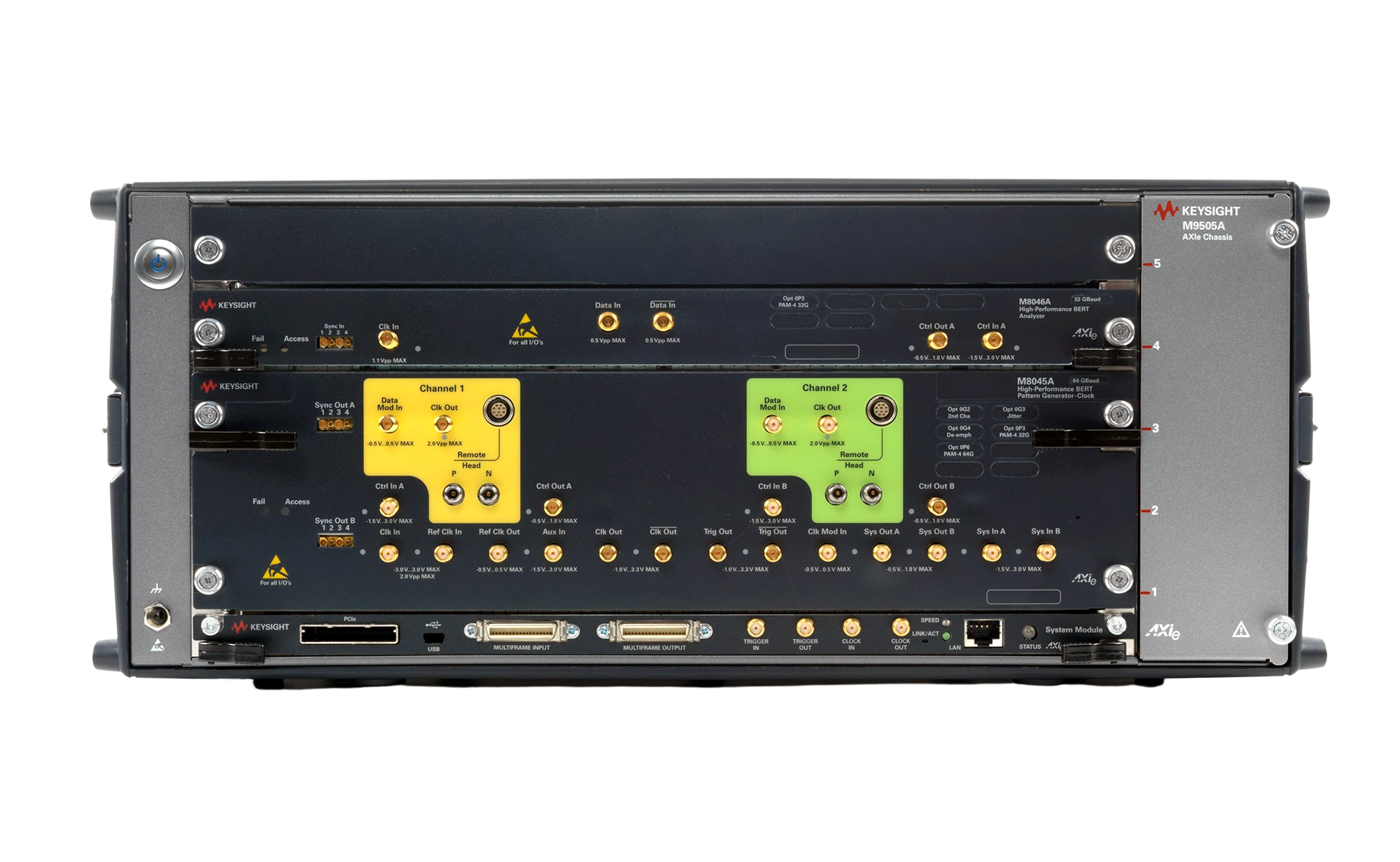
Keysight M8040A: representative image from the Produktseite auf usedtxrx.com.
Which jobs pre-owned instruments still do well
Pre-owned DCAs, BERTs and VNAs remain strong for R&D characterization, fixture and cable S-parameter work, and 100G to 800G-class development. Whether a particular unit can handle 212G lanes depends on its modules, bandwidth and licences, so check the configuration before you buy rather than assuming from the model name.
Used high-speed checklist
- Confirm module bandwidth, the number of channels and the clock recovery options.
- Read the licence list on the instrument; analysis packages are often separate.
- Check the software version and support status.
- Inspect connectors under magnification and use a torque wrench; worn precision connectors spoil measurements.
- Ask for calibration records and when the last calibration was done.
Häufig gestellte Fragen
What is digital-layer interconnect validation?
It measures how many bit errors a complete interconnect produces, and how its forward error correction behaves, while all lanes carry traffic. It complements physical-layer tests such as eye diagrams and S-parameters.
What is the difference between an AEC, ACC and DAC?
A DAC is a passive copper cable. An ACC adds analog signal conditioning, and an AEC adds active electronics such as retimers to extend reach at high data rates.
Do I still need a sampling oscilloscope or BERT if I use FITS?
Yes. Keysight describes FITS as working with DCAs, BERTs and UXR oscilloscopes. Physical-layer tools explain why a link fails; FITS shows whether the complete assembly performs.
Can pre-owned DCAs and BERTs support 800G or 1.6T work?
It depends on the model, modules and licences. Send us your lane rate and modulation and we will check a specific unit before quoting.
Bottom line
FITS-16CH reflects a shift in high-speed testing: physical-layer compliance is necessary but not sufficient at 1.6T. Physical-layer instruments still do most of the design and debug work, and good pre-owned units can carry much of that load. Browse our bit error rate testers, oscilloscopes, network analyzers und optical and communications test equipment, or contact us for a quote.
Quelle: Keysight Technologies, “Keysight Expands Active and Passive 1.6T Copper Interconnect Validation for Scale-Out Data Centers”, October 14, 2026 (Business Wire distribution; the Keysight newsroom lists the release under October 12, 2026). Original announcement: https://www.businesswire.com/news/home/20261014439659/en/Keysight-Expands-Active-and-Passive-1.6T-Copper-Interconnect-Validation-for-Scale-Out-Data-Centers. Product information: Keysight Functional Interconnect Test Solutions.
This article is an independent summary and commentary by TXRX. Quoted passages are attributed to Keysight Technologies. All trademarks belong to their respective owners. TXRX is an independent supplier of new and pre-owned test equipment and is not affiliated with, endorsed by, or an authorized distributor of Keysight Technologies.
Über TXRX — TXRX supplies new and pre-owned RF, microwave, optical and high-speed test instruments to labs and manufacturers worldwide. TXRX pre-owned equipment comes with a 6-month warranty; new equipment carries the manufacturer’s standard warranty. Learn more about TXRX · Contact us for a quote
Drafted with AI assistance and reviewed by the TXRX team.